

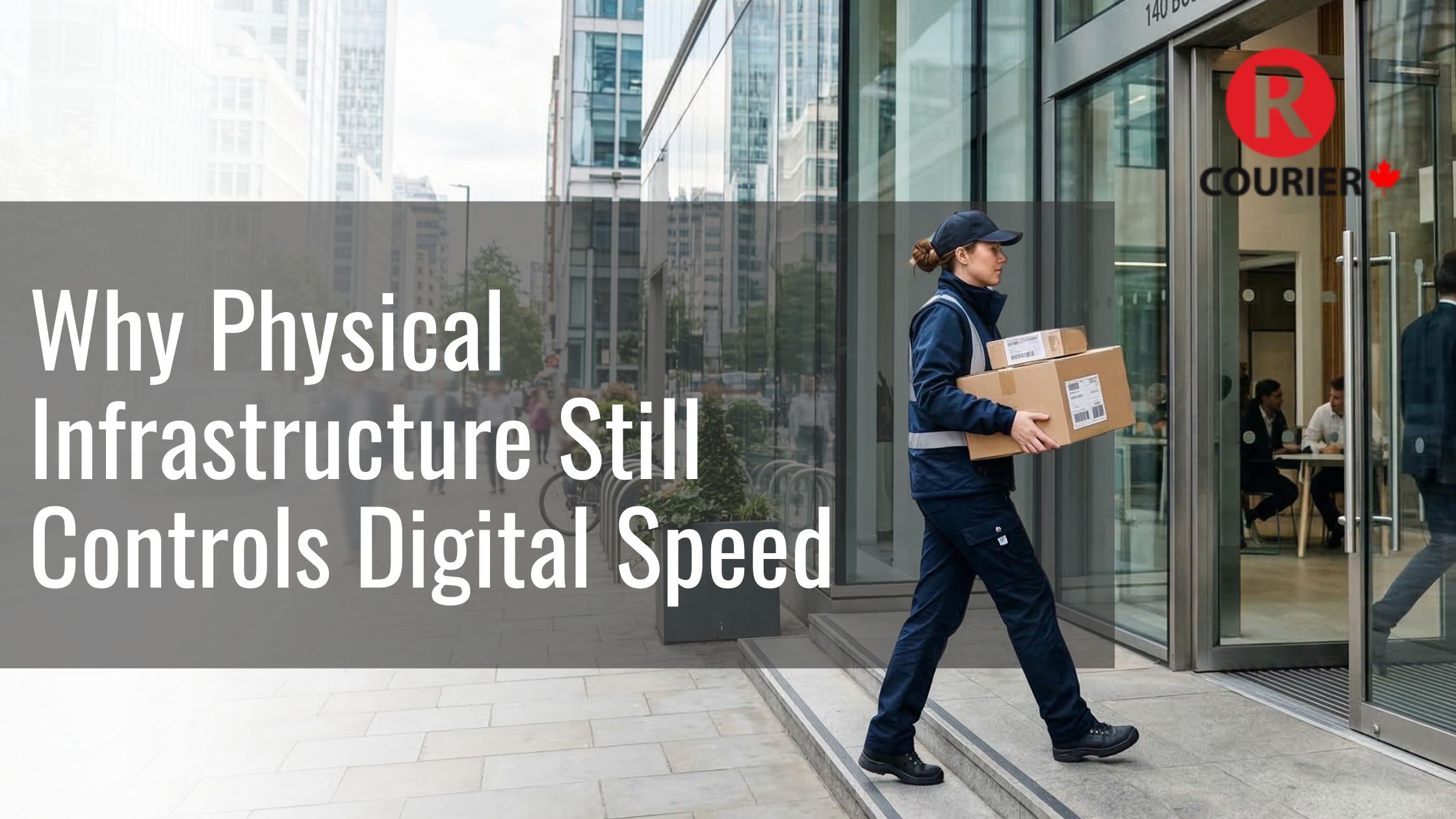
Businesses love to talk about digital speed.
Cloud platforms promise instant access. Automation reduces human delays. Communication tools connect teams across cities in seconds. On the surface, modern business looks almost frictionless.
But behind every fast digital system is something far less glamorous: physical infrastructure.
Servers sit in buildings. Equipment travels between offices. Documents still move between departments. Medical samples, financial paperwork, and legal materials all require physical transportation to reach their destination.
At R Courier, we see this every day. Companies may run on software, but their operations still rely on something much simpler: moving things from one place to another quickly and reliably.
Digital progress has not eliminated physical movement. In many cases, it has made it even more important.
Digital Workflows Still End in the Physical World
Most modern business processes start online. Contracts are drafted digitally. Teams collaborate through shared platforms. Approvals move through automated systems.
But eventually, those digital workflows lead to a real-world step.
A legal agreement may require a signed physical copy. A medical diagnosis depends on a transported sample. A financial transaction might require secure documentation delivered to the right office before a deadline.
The final step determines the real timeline.
A project might move through approvals instantly, but progress stops if critical materials do not arrive when expected. Digital systems accelerate communication, but they cannot replace the need for reliable physical movement.
This is where dependable courier and logistics infrastructure becomes essential.
Our team provides businesses with the operational support needed to turn digital decisions into completed actions through our full range of courier services. Without reliable delivery infrastructure, even the most advanced software systems can stall.
Data Travels Instantly. Equipment Does Not.
Technology companies often talk about how quickly data moves. Cloud platforms allow files to travel across continents within seconds.
But businesses rarely operate on data alone.
Organizations still depend on equipment, tools, and physical documentation to function. Offices require laptops and hardware. Healthcare providers rely on medical supplies. Engineering teams need specialized components delivered precisely when installation begins.
Even companies built entirely on technology ship hardware between data centers and operational hubs.
When those deliveries slow down, productivity slows down with them.
No matter how sophisticated digital systems become, businesses still depend on the speed of physical logistics to execute decisions made online.
The Last Mile Still Determines Operational Speed
The logistics industry often refers to the “last mile” as the final stage of delivery before a package reaches its destination.
In business operations, the last mile is where plans either succeed or fail.
A legal filing must arrive before a court deadline. A replacement component must reach a facility before a system outage grows worse. Medical samples must be transported quickly enough to maintain their integrity.
These are not routine deliveries. They are time-sensitive operational tasks.
At R Courier, we specialize in handling these critical deliveries through our courier services for time sensitive deliveries.
Speed in business is rarely about how quickly information travels. It is about whether the physical piece of the process arrives exactly when it should.
Remote Work Increased Logistics Dependence
When companies shifted toward remote work, many assumed physical infrastructure would become less important.
The opposite happened.
Distributed teams require more logistics coordination, not less.
Organizations now ship laptops, security equipment, documents, and technical tools across cities and provinces to support employees working outside traditional offices.
A new hire might begin onboarding digitally, but they cannot do their job without the physical tools required to perform it.
Each shipment becomes part of operational continuity.
Digital communication tools allow teams to collaborate, but physical infrastructure ensures employees can actually work.
Courier networks now function as part of the operational backbone that supports remote organizations.
Time Sensitivity Has Increased Across Industries
Business timelines are shrinking.
What once took several days now needs to happen within hours.
Healthcare providers rely on rapid transportation for diagnostics and medical samples. Legal professionals operate under strict court deadlines. Financial institutions require secure document transfers that cannot be delayed.
These industries do not have the luxury of flexible delivery windows.
They require precise, dependable logistics infrastructure.
At R Courier, we support organizations that cannot afford delays through specialized medical courier services designed for healthcare providers, laboratories, and clinics.
When timing directly affects outcomes, reliability becomes just as important as speed.
Infrastructure Failures Create Immediate Bottlenecks
Software failures often come with workarounds.
A cloud platform might temporarily go offline, but teams can often continue working through backup systems.
Physical delays do not offer the same flexibility.
If a replacement part does not arrive, manufacturing stops. If critical documents miss a deadline, approvals may be postponed. If equipment arrives late, an entire deployment schedule can collapse.
Physical infrastructure operates beneath digital systems as a dependency layer.
When logistics fails, productivity drops immediately.
This is why businesses increasingly treat logistics partners as operational infrastructure rather than a simple delivery service.

Visibility Turns Logistics Into Strategy
Courier networks have evolved significantly in recent years.
Modern delivery systems now offer real-time tracking and visibility that mirrors the data transparency companies expect from digital tools.
Organizations can monitor shipments, coordinate workflows around confirmed delivery windows, and maintain tighter scheduling across departments.
This level of visibility transforms logistics from a reactive service into a strategic advantage.
When businesses can see exactly where a delivery is and when it will arrive, they can plan with confidence.
Our technology systems at R Courier support this level of operational visibility through tools like ETA board tracking technology, helping organizations coordinate logistics with the same precision they apply to digital systems.
Predictability allows companies to move faster.
National Logistics Networks Enable Digital Expansion
Many companies believe digital platforms automatically make expansion easier.
In reality, entering new markets often reveals the importance of strong logistics infrastructure.
Serving multiple regions requires dependable transportation networks capable of maintaining consistent service standards. Without reliable delivery partners, performance can vary significantly between locations.
Businesses quickly discover that scaling operations requires more than digital tools.
It requires physical infrastructure that supports those tools.
Through our national courier network, we help organizations maintain consistent delivery performance across regions while supporting their operational growth.
Infrastructure allows digital businesses to scale without rebuilding their logistics systems every time they expand.
Secure Transportation Still Matters in Sensitive Industries
Certain industries require more than speed.
They require security and reliability when handling sensitive materials.
Legal firms move confidential documents between offices and courts. Healthcare providers transport diagnostic samples that must remain intact during transit. Financial institutions manage paperwork that cannot be exposed or delayed.
These deliveries demand specialized handling.
Digital Transformation Still Requires Physical Support
Many organizations invest heavily in digital transformation initiatives.
They implement automation systems, adopt new cloud platforms, and introduce advanced analytics tools.
These improvements can dramatically improve decision-making speed.
But successful digital transformation depends on something many companies overlook: physical readiness.
New technology requires hardware deployment. Systems must be installed. Equipment must be maintained. Sensitive materials must be transported securely between locations.
Without reliable infrastructure, digital upgrades struggle to reach their full potential.
Digital systems accelerate decisions.
Physical logistics determines execution.
Speed Is Built on Systems Most People Never See
Customers and clients rarely think about what happens behind the scenes.
They simply expect businesses to operate quickly and reliably.
But fast service depends on dozens of interconnected systems working together.
Digital platforms handle communication. Automation supports workflow efficiency. Data analytics improve decision-making.
And behind it all, physical infrastructure ensures that materials, equipment, and documentation move exactly where they need to go.
Courier networks are one of those invisible systems.
When they work properly, operations feel seamless.
When they fail, the delays become impossible to ignore.
Reliable Logistics Keeps the Digital Economy Moving
Despite the rise of cloud computing and remote collaboration, the modern economy still runs on physical movement.
Medical supplies travel between labs and clinics. Legal documents move between offices and courthouses. Equipment and technology components circulate between facilities.
Even the most advanced organizations depend on these physical connections.
At R Courier, we understand that logistics is not just about delivery.
It is about operational continuity.
Businesses that treat logistics as core infrastructure gain a major advantage. They move faster, operate more reliably, and maintain control over timelines that other organizations struggle to manage.
Digital transformation may reshape how companies work.
But speed will always depend on how efficiently the physical world keeps moving.
Need a Delivery Right Now? Place Your Order in Minutes
When timing matters, waiting should never be part of the process.
At R Courier, we make it simple to schedule a pickup, assign a driver, and keep your delivery moving without delays. Our online ordering system allows businesses to submit shipment details, choose delivery options, and track orders in real time from a single dashboard.
If you already have an account, you can submit your shipment immediately through our secure ordering portal. Just enter your account information, add your delivery details, and our dispatch team will begin processing your request right away!


