

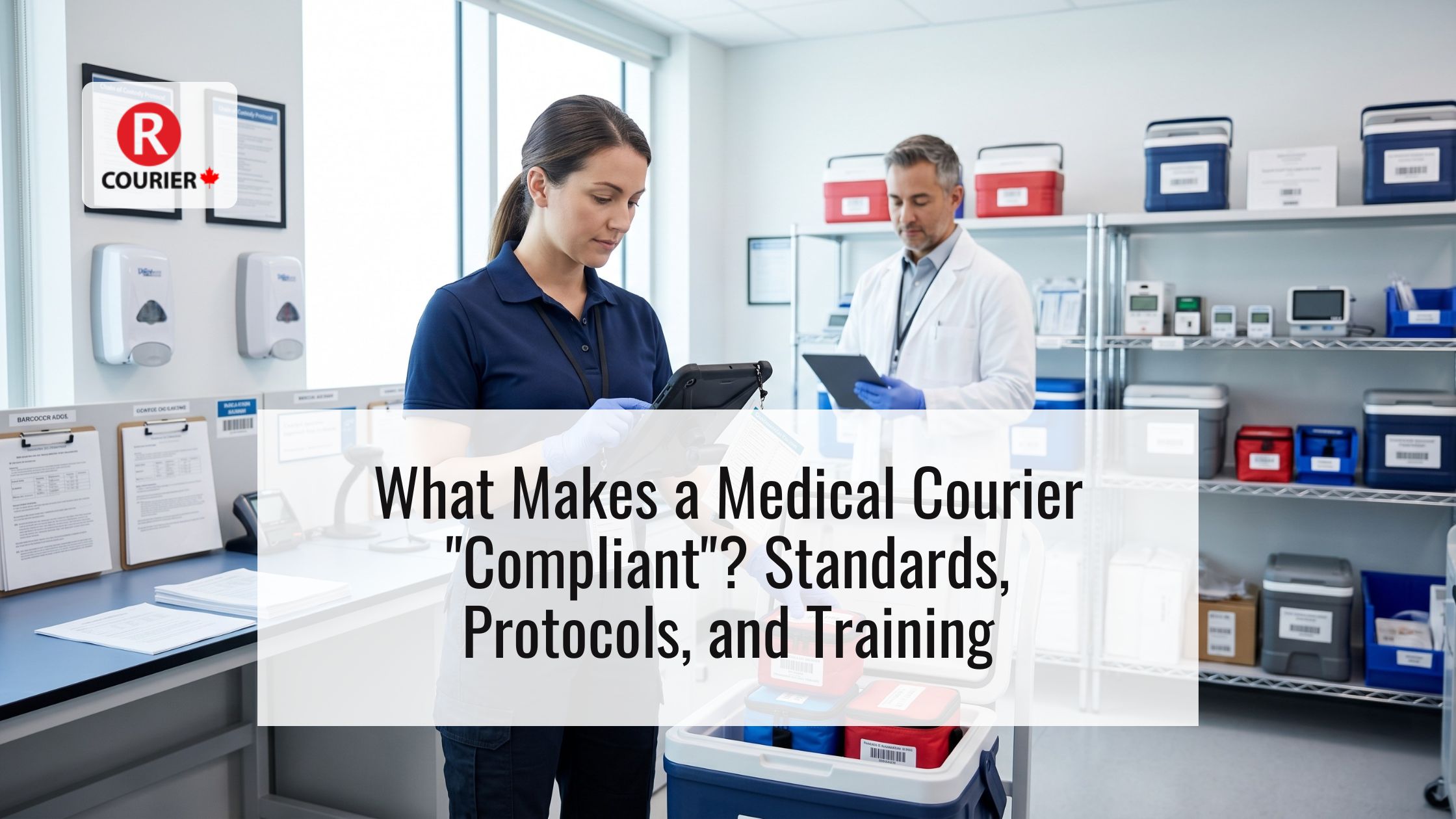
Not every courier company is equipped to move medical cargo. A general logistics provider can deliver a package on time and still fail completely when that package contains a blood specimen, a controlled substance, or temperature-sensitive medication that determines a patient’s treatment plan.
Compliance is what separates a medical courier company from a general delivery service. It is not a single certification or a checkbox on a form. It is a system of interlocking standards, protocols, training requirements, and documentation practices that governs every step of every delivery, from the moment a package is picked up to the moment it is confirmed received.
Here is what genuine compliance looks like, and why it matters.
What “Compliant” Actually Means in Medical Courier Services
In the context of medical courier services, compliance refers to consistent adherence to a set of regulatory, operational, and ethical standards that protect patients, healthcare providers, and the integrity of the materials being transported.
Those standards come from several sources:
HIPAA (Health Insurance Portability and Accountability Act)
Governs the handling of protected health information. Any courier transporting documents, specimens, or materials linked to patient records must have protocols in place to ensure that information is not accessed, disclosed, or compromised during transit.
PHIPA (Personal Health Information Protection Act)
is the Canadian equivalent, governing how personal health information is collected, used, and disclosed in Ontario. Medical couriers operating in this province are required to handle patient-linked materials in full accordance with PHIPA standards.
OSHA (Occupational Safety and Health Administration)
Standards govern the safe handling of biological materials, sharps, and hazardous substances. Couriers transporting specimens or medical waste must be trained in universal precautions, proper containment, and exposure response procedures.
Transport Canada
regulations apply to the shipment of dangerous goods, including certain biological substances and pharmaceutical categories that require specific packaging, labelling, and handling protocols.
Compliance is not optional in any of these areas. Non-compliance exposes healthcare providers to regulatory penalties, compromises patient safety, and creates liability that extends across the entire chain of custody.
Chain of Custody: The Foundation of Medical Transport Integrity
Chain of custody is the documented record of who handled a specimen or medical item, when they handled it, and what condition it was in at each transfer point. It is one of the most critical compliance requirements in medical courier services, and one of the most frequently overlooked by providers without specialized training.
A broken chain of custody can invalidate a laboratory specimen, render a legal or clinical document inadmissible, or create gaps in a patient’s care record that are difficult or impossible to reconstruct. In a medical context, those consequences are not administrative. They are clinical.
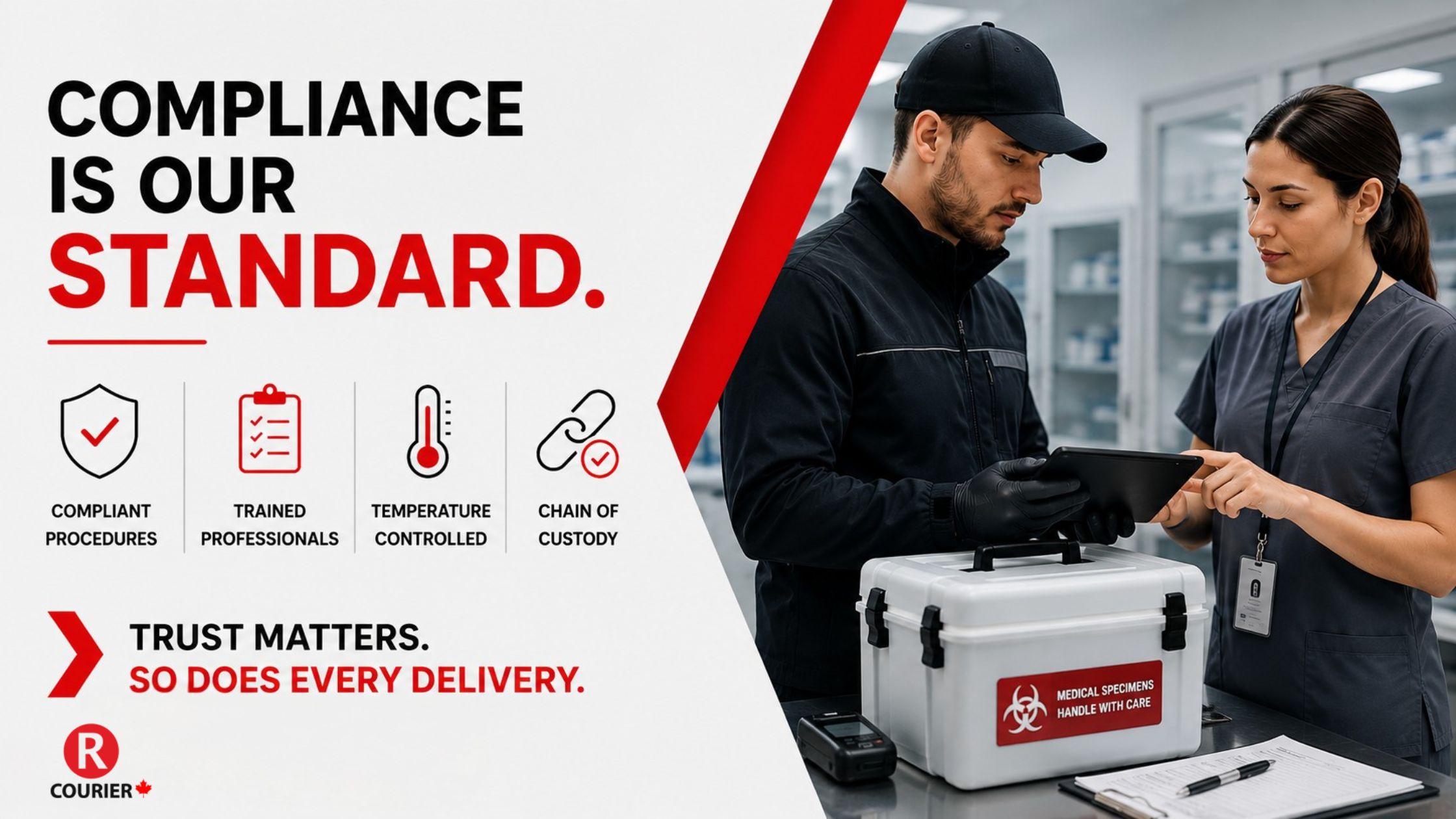
A compliant medical courier maintains an unbroken chain of custody through rigorous documentation at every handoff, confirmed identity verification at pickup and delivery, tamper-evident packaging, and electronic logging that creates a time-stamped audit trail.
Understanding the different types of medical delivery and the specific chain of custody requirements that apply to each one is essential knowledge for any courier operating in the healthcare space. Specimen transport, pharmaceutical delivery, and medical records each carry distinct requirements, and a compliant courier knows the difference.
Handling Protocols for Specialized Medical Materials
Compliance is not only about documentation. It is about how materials are physically handled from the point of pickup through final delivery.
Biological specimens must be contained in appropriate primary and secondary packaging, maintained at required temperatures, and transported in leak-proof carriers that meet transport regulations. A specimen that arrives at the laboratory degraded due to improper handling has the same outcome as one that never arrived at all.
Temperature-sensitive medications and biologics require validated cold chain management: insulated carriers, temperature monitoring, and documented evidence that materials remained within required ranges throughout transit. Deviation from temperature requirements can render medications ineffective or unsafe, with consequences that extend directly to patients.
High quality protocols for packaging and handling are not suggestions. They are the operational baseline that determines whether a delivery is medically valid or not.
Sharps, hazardous materials, and regulated medical waste require additional handling protocols governed by both OSHA standards and provincial regulations. Couriers must be trained in the identification, containment, and transport of these materials before they are permitted to handle them.
Driver Training and Certification Requirements
A compliant medical courier is only as reliable as the people making the deliveries. Training is where compliance becomes operational rather than theoretical.
Drivers working in medical logistics require training that general courier certifications do not cover. At minimum, that includes:
WHMIS (Workplace Hazardous Materials Information System)
Certification for the handling of hazardous biological and chemical substances.
TDG (Transportation of Dangerous Goods)
Certification for any driver transporting materials that fall under federal dangerous goods classifications, including certain biological substances and pharmaceutical categories.
PHIPA awareness training
Covers the handling of materials linked to personal health information and the obligations that attach to that handling.
Universal precautions and infection control
Training that prepares drivers to respond appropriately to spills, containment failures, or exposure incidents in the field.
Chain of custody procedures
Specific to the types of medical materials being transported, including documentation requirements, verification protocols, and escalation procedures for anomalies.
Ongoing training matters as much as initial certification. Regulations change. Protocols are updated. A compliant medical courier invests in continuous driver education rather than treating certification as a one-time requirement.
Documentation and Audit-Ready Reporting
Compliance without documentation is not compliance. It is an intention. Healthcare providers, laboratories, and regulators require evidence that protocols were followed, and that evidence lives in the documentation that accompanies every delivery.
A compliant medical courier maintains records that include pickup and delivery timestamps, driver identification, package condition at handoff, temperature logs where applicable, recipient confirmation, and exception reports for any deviation from standard procedure.
Those records must be organized, retained according to applicable regulatory requirements, and accessible for audit on request. A provider that cannot produce complete delivery documentation when a question arises about a specimen, a medication, or a medical record is not a compliant provider, regardless of what their internal policies say.
Real-time delivery updates are an increasingly important component of this documentation layer. When healthcare providers can see exactly where a delivery is and receive confirmation the moment it is completed, the documentation gap that has historically existed between dispatch and delivery narrows significantly.
Technology as a Compliance Tool
Modern medical courier compliance is not achievable through paper-based systems alone. The volume, time-sensitivity, and documentation requirements of healthcare logistics demand technology infrastructure that can track, record, and report in real time.
ETA board technology gives healthcare clients continuous visibility into delivery status, with updates logged automatically and accessible through secure credentials. That visibility is not just a convenience. It is a compliance feature. It creates a time-stamped record of every status update, reduces the risk of communication failures between courier and client, and supports the audit trail that healthcare providers are required to maintain.
The relationship between physical infrastructure and digital tracking capability is direct: the quality of real-time data depends on the operational systems behind it. A compliant medical courier invests in both.
The Consequences of Non-Compliance
Non-compliance in medical courier services is not a back-office problem. It has clinical, legal, and financial consequences that affect patients, providers, and courier companies alike.
Regulatory penalties for HIPAA and PHIPA violations can be substantial, and they attach to the healthcare provider as much as to the courier they contracted. Providers are responsible for ensuring that their logistics partners meet applicable standards. Choosing a non-compliant courier is not a defence.
Beyond regulatory consequences, non-compliance creates direct patient risk. A specimen that is mishandled may produce an inaccurate diagnostic result. A medication that breaks cold chain may be administered to a patient without anyone knowing it has been compromised. A chain of custody failure may delay treatment while a result is disputed or reordered.
The delivery of emergency medical supplies illustrates the stakes most clearly. When the materials being transported are time-critical and patient outcomes depend on their integrity, the cost of a compliance failure is measured in more than money.
What to Look For in a Compliant Medical Courier
When evaluating a medical courier provider, compliance should be the first filter, not an afterthought.
Ask for documentation of driver certifications. Request information about chain of custody procedures and how exceptions are handled. Ask how temperature-sensitive materials are monitored during transit. Confirm that the provider’s tracking and documentation systems can support the audit requirements of your organization.
A provider working in trusted hands is one that can answer those questions without hesitation, because the systems, training, and documentation are already in place.
Compliance is not a premium feature. In medical logistics, it is the minimum standard. The couriers who understand that distinction are the ones healthcare providers can rely on when it matters most.
To learn more about R Courier’s compliance standards and medical delivery services, visit Rcourier.com.


